HOSPITALITY CHECKPOINT SPOTTER SERVICE
http://www.hospitalitycheckpoint.com/
BARTENDER THEFT: Bar Theft, Palming Stolen Money, Stolen Money to Tip Jar, Underage Drinking, Dram Shop Concerns
Bartender Summary
The agent observed the following bartenders the evening of June 30th:
–Indoor Bar
· Xxxxx: Caucasian male, 6’2”, medium build, short dark hair
· Xxxxx: Caucasian male, 6’0”, medium build, short dark hair
–Near Bar
· Bartender 3: Caucasian male, 6’1”, medium build, short spiked brown hair
· Bartender 4: Caucasian male, 6’2”, medium build, short dark hair




The agent initially approached the nearer of the two outdoor bars at 7:17. At that time, all three bartenders were doing their best to keep up with the demand, but from the moment the agent walked in, it was obvious that they were beyond the limit of how much business they could keep up with. And while both of them were working gamely to do all that they could, it was six minutes before one of them was able to get to a given guest after her arrival.
This was not an isolated incident either, as the experience was typical of the average guest. Even so, after initially speaking to the agent at 17:23, Bartender 3 was able to present the ordered beverage a mere two minutes later. Though it is worth noting that no beverage napkins were used by either bartender at any point. Of some additional concern, the agent noted that the bartender never actually rang the order in. Rather, he approached the POS, and registered a flurry of screen touches that ultimately culminated in a “No sale” screen and the cash being split between the register and tip jar. Again, this experience was sadly typical. (see photo below from 8:20).
In addition to multiple “No sale” ring-ins, the agent also witnessed another common practice effective for hiding cash theft: rather than create and close out each individual order, both Bartenders 3 and 4 had a tendency to leave a tab open at all times, which they would add drinks to and apply cash payments to repeatedly without closing out. In addition to making the cash sales record a confused jumble, this also gives a readout less than a centimeter in size stating the change due back to the guest. Obviously, in a bar where the nearest guest is ten feet away, this is a serious problem.
Yet two additional methods of outright theft were observed. At 8:07, Bartender 3 received a drink order and a stack of bills with a suggestion to “keep the change.” Rather than ring the order in, Bartender 3 held onto it, palmed in one of his hands while going about stocking work, until he eventually dropped it directly in the tip jar.
Similarly, at 8:34, Bartender 4 poured two draft beers for a guest, quoted her a price of $10, then went to the POS, and rang it in for a single draft, pressing the cash button as quickly as possible so that the large “$5.00” display was visible for only a fraction of a second, and then dropped the remainder and tip in the tip jar.
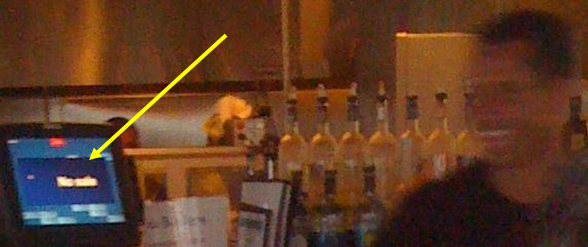
Each of these theft methods relies on quoting a price, waiting for the guest to present cash, and then ringing in something unorthodox to disguise the theft of the overage.
One practice that would go a long way to eliminating these practices would be to insist that bartenders announce the price only after having rung in the items. This would at least make the practices above more difficult, but the fact that bartenders feel free to just ring in “No sales” and drop in cash means that they are stealing with impunity. A good way to address this problem would be to have surprise cash drawer changes at random and unannounced times, making it easy for management to prove that some bartenders have impossible overages. Also, since theft was consistently observed only at the outdoor bars, this would be a way of extending management’s control over the satellite bars that seem to operate with a sense of impunity.
Given the profit motivation the bartenders displayed, it surprised the agent to never see either of them offer food to a guest or even try to upsell to a more expensive brand of liquor, easy ways to increase check and tip averages.
Also, paradoxically, the bartenders were very slow about offering additional drinks to those guests whose had gone empty. Initially, they were very busy with guests, then with cleaning up and restocking, but after this period, they tended to wait around to be approached rather than offer new drinks to guests sitting there with empties.
The agent also never observed either bartender giving any guest a check for any cash order at any time. They simply did not do it. This was even true at the inside bar where rampant theft methods were not observed.
Additionally, other, numerous operating controls seemed to have broken down, especially the system for checking ID. It is possible that the bartenders were under the impression that IDs were being checked at the door, because no bartender in the establishment or out was ever seen to ask for identification of any guest. This is obviously a big enough risk for the establishment, but on top of that, much of the crowd that evening was young, including several people that were clearly under 30. Additionally, by the end of the evening multiple guests made statements both to the bartenders and to fellow patrons to the effect of their being completely intoxicated. Sure enough, both guests showed all the symptoms of visible intoxication, yet they continued to receive drinks from Bartenders 3 and 4.
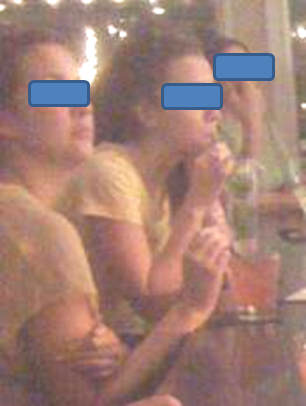
Even more worryingly, at 9:27, the agent observed Xxxxx serving a Mojito and a Pomonat to two girls that appeared to the agent to be underage (pictured at left) . What’s more, Xxxxx not only never carded them, he was also never seen to ring the drink in, meaning that he either delayed the ring-in considerably, or they were given away without being properly comped and accounted for. Agent never observed the drinks to be accounted for.
Obviously, it goes without saying that under New Jersey’s dram shop law, these are massive sources of liability to the establishment, as any damages caused to either any individual or any property by a minor who has been served in a restaurant can be considered the liability of the establishment, and can be recouped by litigation. In fact, the law is so stringent, that even minors who have not been served on the premises, but have been seen to have been intoxicated on the premises and then go on to cause damages can be a source of liability for the establishment, as the establishment is legally obligated to stop the process. This is why it is so essential that all guests be identified in terms of age upon entry to the establishment. Of course, when it comes to intoxicated guests, the liability exists regardless of guests’ minor status.
On the other hand, there were minimal problems with correct pouring controls at both bars. The only overpour was actually poured by a chef (see “Managers” section for details).
All bartenders appearance was always professional and hygienic, with no cause for concern with respect to their hand washing. The agent did observe both outdoor bartenders and Xxxxx drinking from plastic cups though.
The outdoor bar farthest from the entrance was closed.
Manager Summary
· Patio Manager: Caucasian male, 6’0”, short dark hair and goatee , average build, black short-sleeved collared shirt labeled “Baia,” and black slacks (pictured at right)
· Chef: Caucasian male, 6’0”, short light brown hair in a baseball cap, glasses, wearing a black chef’s uniform monogrammed with a name beginning “Sch”
For the most part, the agent only observed the Patio Manager. He was generally busy and effective though. He was first seen in conversation with the hostess outside the patio bar at 8:16, then was seen circulating around the patio, in one case talking to a guest.
Next, at several times between 8:50 and 9:28, he was seen preparing bar drinks and taking them outside, presumably to help the swamped bartenders.
The only negative finding about the Patio Manager is that he was just five feet away when Xxxxx was seen presenting the alcohol to the seemingly underage guests.

Finally, the Chef described above was briefly observed at 9:20 when he stepped behind the indoor bar, grabbed a goblet, poured himself an eight-count (>3 oz) of Grey Goose, emptied a can of Red Bull over it, and then walked back into the kitchen, taking a large gulp of the drink as he walked. It was not observed to be comped in the POS.
While the Patio Manager was doing a laudable job of assisting his staff, in the agent’s opinion, his time might have been better spent by inspiring a bit of fear of authority in his bar staff.
There were no guest problems at any point that required manager intervention.
BARTENDER THEFT
Michael Zenner – CEO
Hospitality Checkpoint LLC
hospitalitycheckpoint.com
bartheft.com (blog)
PO BOX 995 Gilbert AZ 85299
Office: 480-777-7056
Toll Free: 800-880-0811
© Hospitality Checkpoint LLC 2015